Case study
Building an AI product portfolio from the ground up.
- Employee #1
- Enterprise AI
- Brand · Positioning · GTM
Nothing existed yet - including a clear way to explain what we were building, who it was for, and how different products should show up in the market.
01
Context
I joined WebTiga as Employee #1 at an early stage, when the company was building AI products across different audiences and use cases.
Marketing, brand positioning and go-to-market foundations were still being established. The challenge was not simply creating marketing assets.
It was creating clarity around what each product was, who it was built for, how it should be positioned, and how different audiences should understand it.
The product portfolio included offerings with different audiences and buying contexts. This meant the same positioning or brand narrative could not simply be applied across everything.
02
My role
I worked across brand strategy, product positioning and go-to-market, partnering directly with the founding team and coordinating with product and external creative teams.
My role involved helping translate emerging AI capabilities into clearer market narratives and building the foundations needed for products to communicate differently to different audiences.
This included brand and messaging strategy, product positioning, B2B and B2C differentiation, go-to-market frameworks, website and marketing asset development, product decks and sales collateral, and coordination with external creative agencies.
03
One company. Different audiences.
A major challenge was that WebTiga's products could not be marketed using a single positioning approach.
Enterprise buyers and consumers evaluate products differently.
Enterprise audiences need clarity around business value, capabilities, use cases and how a product fits into their organisation.
Consumer audiences respond more directly to relevance, usability, personality and immediate product value.
Part of my work involved helping establish clearer differentiation between these audiences rather than applying one generic AI narrative across every product.
04
B2B positioning
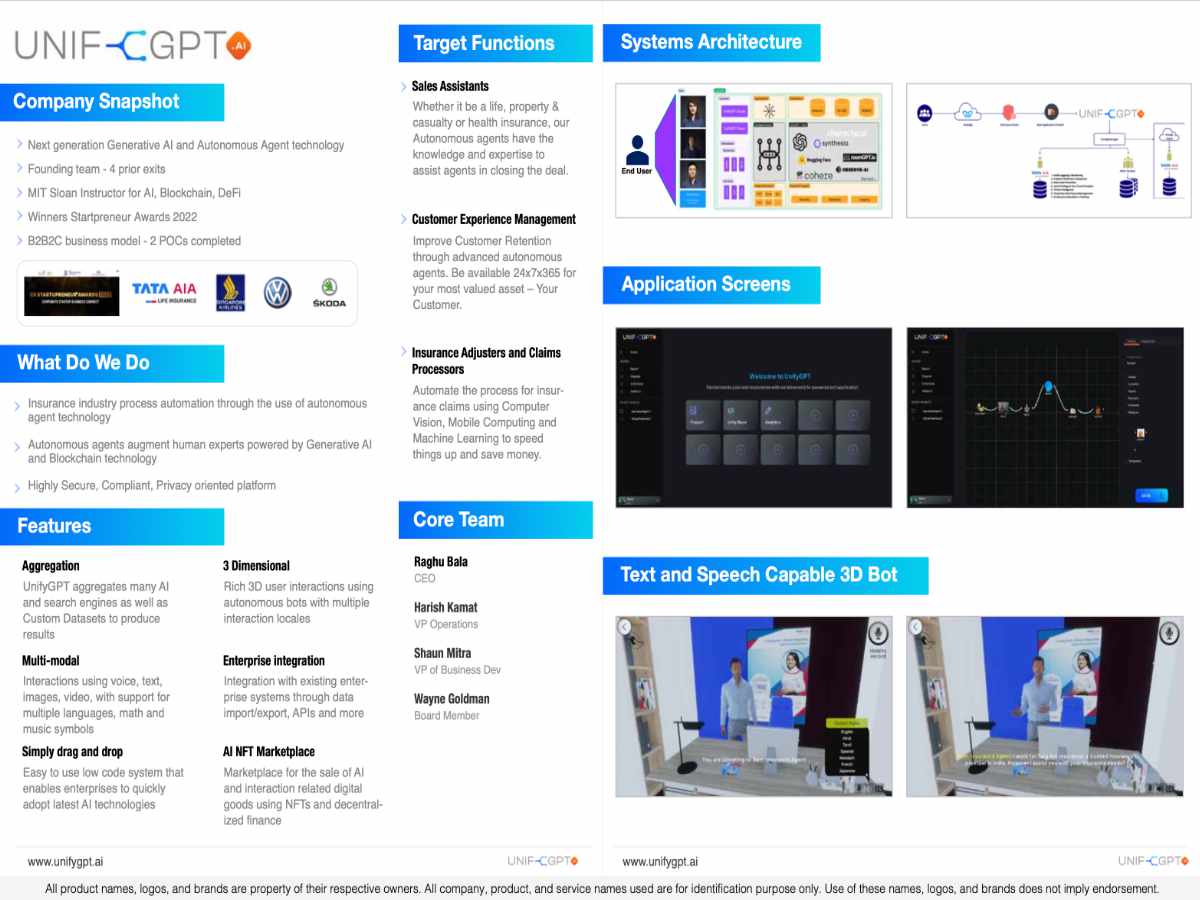
For UnifyGPT, the challenge was translating a broad and evolving AI capability into a proposition enterprise buyers could understand.
The product needed to move beyond simply being described as an AI platform.
The positioning work focused on making the value clearer for enterprise audiences by connecting capabilities to business contexts, use cases and customer problems.
I contributed to enterprise product positioning, messaging architecture, customer-focused value propositions, go-to-market direction, website and product communication, and sales and presentation materials.
The core problem was translation: turning technical capability into language that an enterprise buyer could understand, evaluate and act on.
05
B2C differentiation
The work around Twin.bot required a different approach.
Unlike an enterprise product, the positioning needed to consider a broader consumer audience and a more direct relationship with the product.
The challenge was to create differentiation without relying on the same enterprise-focused language used for UnifyGPT.
I contributed to developing differentiated messaging and positioning that helped define the product's audience, its value proposition, how it should communicate differently from the enterprise offering, and its role within the broader WebTiga product ecosystem.
The audience, expectations and communication model were different — and the product identity needed to reflect that.
06
Building product identities
One of the most important parts of the work was establishing clearer product identities.
Rather than communicating every product through a single generic AI narrative, the goal was to create enough differentiation for each product to have a clearer purpose, a more specific audience, distinct messaging, relevant value propositions, and appropriate communication and marketing assets.
This created a stronger foundation for product marketing and future go-to-market activity.
The work sat at the intersection of brand strategy, product positioning, audience understanding and go-to-market.
07
From positioning to market presence
The strategy needed to become something tangible.
I worked across the development of marketing and commercial assets that translated positioning into customer-facing communication.
This included website planning and messaging, product decks, brand guidelines, sales collateral, launch-ready marketing assets, and coordination with external design and creative agencies.
The goal was to ensure that positioning did not remain an internal strategy exercise. It needed to influence how the products actually appeared in the market.
08
GTM and market direction
The positioning work became a foundation for early go-to-market decisions.
It helped provide a clearer reference point for which audiences to approach, how products should be described, which customer problems to prioritise, how enterprise and consumer communication should differ, and how products could be introduced without creating confusion between offerings.
At this stage, positioning was closely connected to product development.
Clarifying the market story influenced what needed to be communicated, what marketing assets needed to be created and how the products could be introduced to potential users and buyers.
09
Reflection
Early-stage product marketing is not just about promotion.
When products, audiences and categories are still evolving, marketing often helps create the language and structure around how the business understands itself.
At WebTiga, the work involved building foundations across brand, product positioning, B2B differentiation, B2C differentiation, messaging, go-to-market and marketing infrastructure.
The most important contribution was helping turn emerging AI products into clearer market propositions while recognising that different audiences required fundamentally different ways of communicating value.
Building a product is one challenge. Building clarity around it is another.